Public Transport App
Jaipur Ride (Metro)
A high-performance public transit routing engine with 1,500+ Play Store downloads and 50,000+ website impressions, utilizing client-side Breadth-First Search (BFS) pathfinding over static transit graphs.
How I got this idea
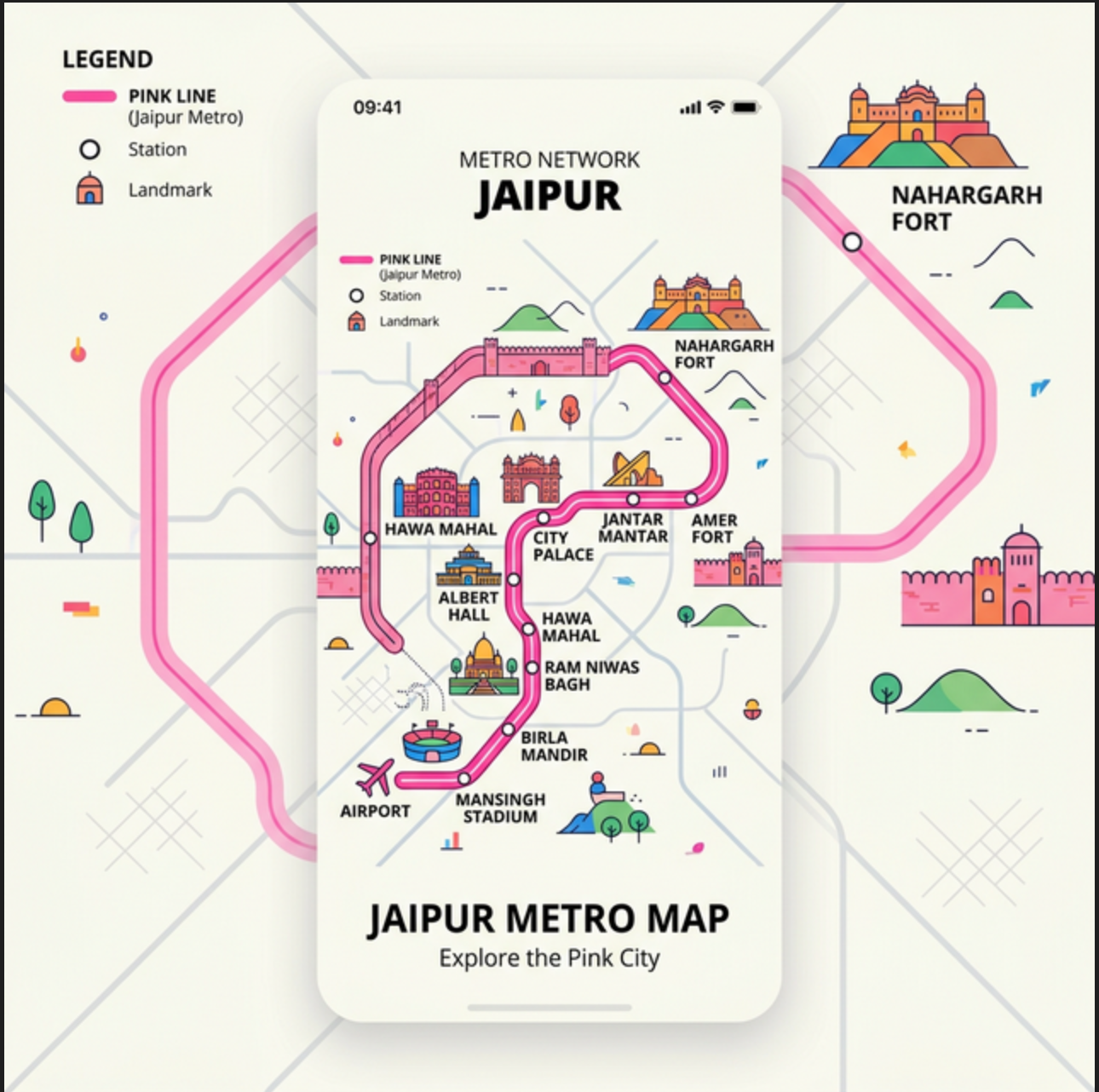
I noticed that people in Jaipur had a really hard time finding correct metro and bus timings, often relying on rumors, random Google searches, or scattered WhatsApp messages.
Problem
- Commuters in Jaipur lacked an offline-capable, unified transit planner showing correct schedules, interchange zones, and ticket fares.
- Existing mapping platforms suffered from high API loading latencies and required continuous internet connectivity, creating friction for tourists in underground stations.
Solution
- Engineering Approach: Developed a Progressive Web Application (PWA) client that caches and processes all routing calculations locally on the device.
- Architecture: The application loads the entire transit network from a highly compressed static JSON adjacency list representation, executing search traverses entirely in-browser.
- What I Personally Built: Programmed the local BFS pathfinding algorithm, compiled the transit coordinate JSON database, designed the responsive routes page, and published the production Android app on Google Play.
- Current Status & Result: Deployed production platform with over 1,500+ organic Android app downloads on Google Play, 50,000+ website impressions, and 250+ Monthly Active Users (MAU) in Jaipur, India.
Live Adoption & Traction Metrics
Google Play Live1.5K+Play Store Downloads
50K+Web Impressions
<10msBFS Pathfinding
15KBTransit Graph
React.jsJavaScriptHTML & CSSVercel
Hardest Technical Challenge
Eliminating external map API lookup latencies and cellular network dependence. Solved this by compiling Jaipur's transit routes into a 15KB JSON adjacency list. Implemented a client-side Breadth-First Search (BFS) pathfinding algorithm that executes locally on the device's CPU, returning complete route, fare, and station breakdowns in under 10ms with zero server calls.
Project Demo / Interface
What I learned
- Breadth-First Search (BFS) graph traversal and JSON data serialization.
- Client-side caching strategies and Progressive Web App (PWA) asset management.
- Responsive, mobile-first interface compilation optimized for users on the move.